Innate asymmetry is the starting point
The liver, heart, lungs, and diaphragm create a natural right-sided bias. That is not pathology. It becomes a problem when breathing mechanics can no longer manage it.
Lab Notes 01 / NotebookLM audio
The first AHPL Lab Notes release: a patient-friendly audio field guide on why breathing mechanics can shape posture, joint freedom, tissue remodeling, and how your body manages force.
Episode 01
Listen in your browser
Interactive research bot
This local bot searches the available NotebookLM source pack: the diaphragm study posts, ZOA audit, protocol notes, and mechanobiology blueprint. It is built for study, coaching language, and clinical reasoning support.
The clinical thesis
The podcast translates diaphragm research into a practical movement model: restore position, retest motion, then load the new range long enough for the tissue environment to change.
The liver, heart, lungs, and diaphragm create a natural right-sided bias. That is not pathology. It becomes a problem when breathing mechanics can no longer manage it.
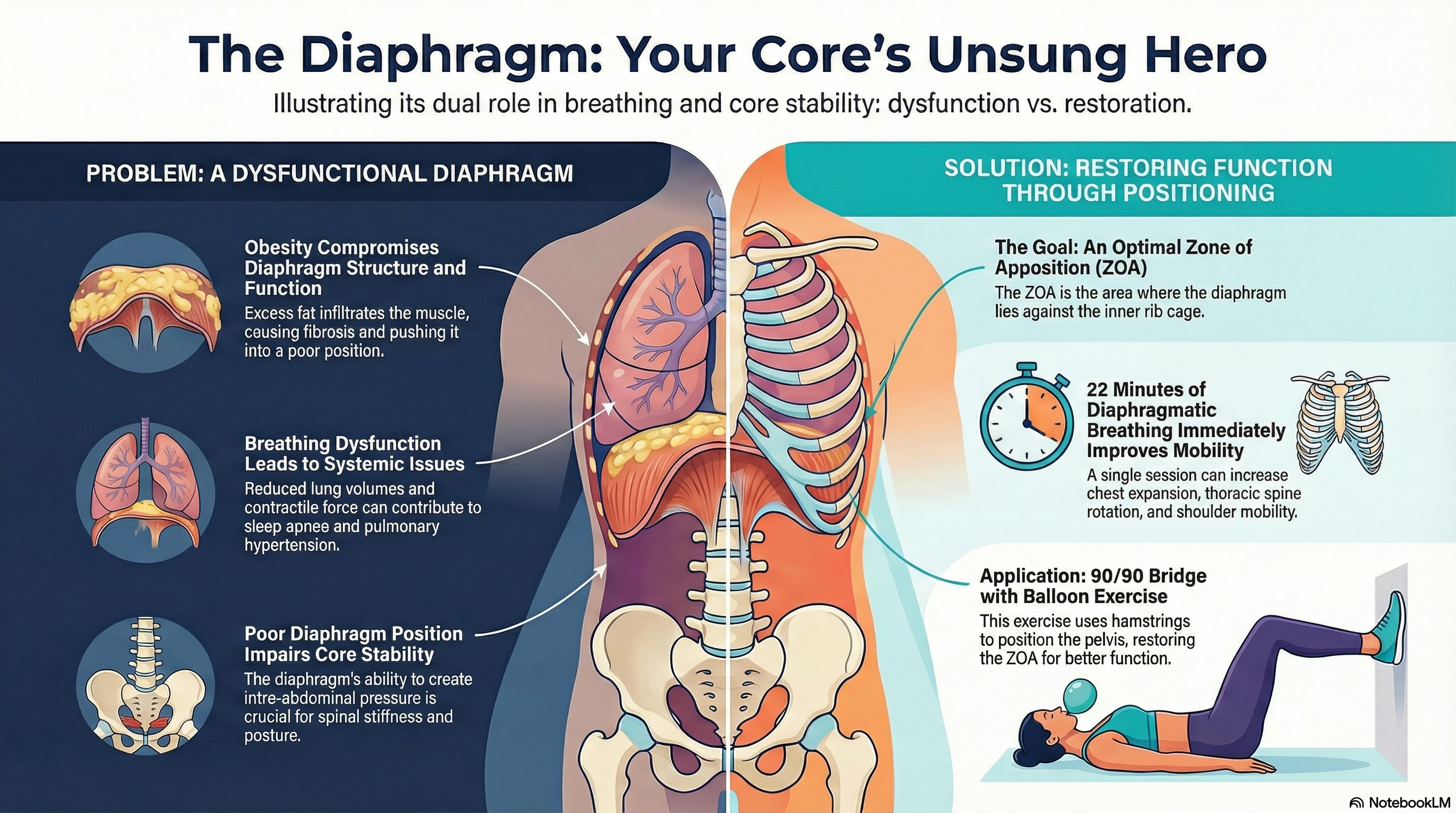
When the diaphragm is domed and the lower ribs are organized, it can help stabilize the spine. When ribs flare and the dome flattens, the system loses leverage.
Neck breathing, lumbar extension, thoracic rounding, and rib counter-rotation are escape routes. The body is choosing stability, even when the cost is restricted movement.
The remodeling clock
That is the bridge between the quick clinical win and the longer plan. The first retest tells you if breathing is a driver. The next months teach the tissue what to become.
Use targeted breathing to see whether thoracic, shoulder, or hip motion changes when the pressure system gets a better position.
Fibroblasts can begin to memorize a stiff mechanical environment quickly, which helps explain why compensation stops feeling temporary.
Sustained loading and repeated positional inputs are what give tissue enough signal to rebuild toward compliance and control.
What to listen for
Strengthening the abs misses the point if the diaphragm is flattened and the ribs cannot give it a stable contact zone.
Resisted exhale pulls the lower ribs down and back, restores dome position, and teaches the inhale to happen without losing pressure.
End-range isometrics give connective tissue and the nervous system a reason to keep the new range instead of treating it as a threat.
Dense tissue in one region changes tension across the network. A rib cage problem can show up as a hip, shoulder, or neck problem.
Bring it back to the body
That is what we test in the lab: rib position, pressure strategy, range of motion, and whether a breathing reset changes the numbers immediately.